
Will Collins Will Collins
0 Course Enrolled • 0 Course CompletedBiography
JN0-683学習資料、JN0-683専門試験
もちろん、資格試験を審査するとき、非公開にすることはできません。テストJN0-683認定に関連する新しいポリシーと情報に注意する必要があります。ユーザーの便宜を図るため、ホームページでJN0-683テスト資料を更新し、資格試験に関連する情報をタイムリーに更新します。年次認定試験は、内容はほぼ同じですが、各年のポリシーとして、対応する試験パターンのグレーディング基準とホットスポットが変更されます。JN0-683テスト準備は、ユーザーが最短時間で合格するのに役立ちます。試験。
Juniper JN0-683 認定試験の出題範囲:
| トピック | 出題範囲 |
|---|---|
| トピック 1 |
|
| トピック 2 |
|
| トピック 3 |
|
JN0-683専門試験 & JN0-683試験対策書
JuniperのJN0-683は専門知識と情報技術の検査として認証試験で、Fast2testはあなたに一日早くJuniperの認証試験に合格させて、多くの人が大量の時間とエネルギーを費やしても無駄になりました。Fast2testにその問題が心配でなく、わずか20時間と少ないお金をを使って楽に試験に合格することができます。Fast2testは君に対して特別の訓練を提供しています。
Juniper Data Center, Professional (JNCIP-DC) 認定 JN0-683 試験問題 (Q39-Q44):
質問 # 39
You are using E8GP peering in an underlay IP fabric. Which two statements are correct in this scenario?
(Choose two.)
- A. EBGP peering does not require an IGP protocol tor adjacency establishment.
- B. Every leaf node has a peering session to every other leaf node.
- C. EBGP peering requires an IGP protocol tor adjacency establishment.
- D. Every leaf node has one peering session to every spine node.
正解:A、D
解説:
* Understanding EBGP in an IP Fabric:
* EBGP (External Border Gateway Protocol) is commonly used in IP fabrics to establish peering between routers, such as leaf and spine nodes, without relying on an Interior Gateway Protocol (IGP) like OSPF or IS-IS.
* IGP Requirement for EBGP:
* Option B:EBGP peering does not require an IGP for adjacency establishment. This is because EBGP peers are typically directly connected, and BGP establishes its own sessions without needing an underlying IGP.
* Leaf-to-Spine Peering:
* Option C:In a typical IP fabric, each leaf node establishes an EBGP session with every spine node. This ensures full connectivity between leaves and spines, facilitating efficient routing and forwarding within the fabric.
Conclusion:
* Option B:Correct-EBGP does not require an IGP for establishing peering sessions.
* Option C:Correct-Each leaf node peers with every spine node, which is a standard practice in IP fabrics to ensure connectivity and redundancy.
質問 # 40
Exhibit.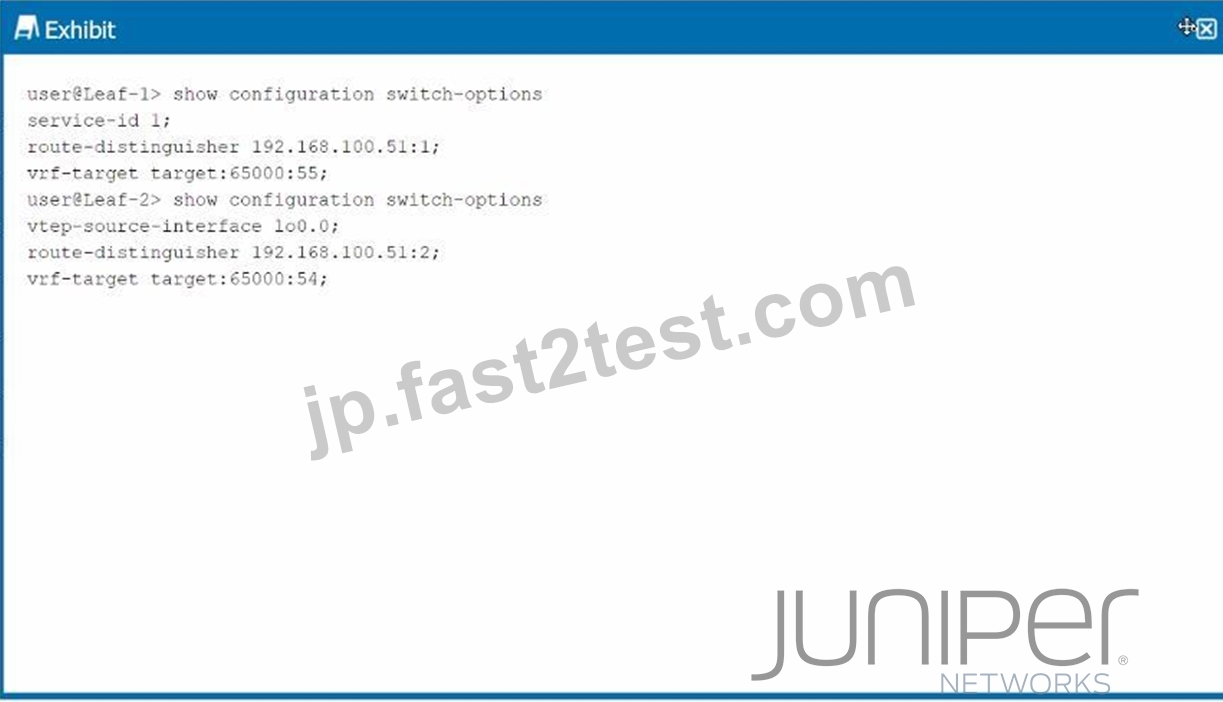
Connections between hosts connected to Leaf-1 and Leaf-2 are not working correctly.
Referring to the exhibit, which two configuration changes are required to solve the problem? (Choose two.)
- A. Configure the setswitch-options vtep-source-interface100. 0 parameter on Leaf-1.
- B. Configure the set switch-options vrf-target target: 65000:55 parameter on Leaf-2.
- C. Configure the set switch-options service-id 1 parameter on Leaf-2.
- D. Configure the setswitch-options route-distinguisher 192.168.100.51:2 parameter on Leaf-1.
正解:B、C
解説:
* Review of the Exhibit:
* The exhibit shows the switch configuration for Leaf-1 and Leaf-2. The configurations include route distinguishers, VRF targets, and service IDs, all of which are crucial for ensuring proper operation in an EVPN-VXLAN environment.
* Service-ID Consistency:
* The service ID must be consistent across all participating leaf devices in the same EVPN instance to ensure that they are part of the same VXLAN overlay network.
* VRF Target Consistency:
* The vrf-target parameter must also be consistent across devices to ensure that VRFs (Virtual Routing and Forwarding instances) are correctly imported and exported between leaf nodes.
Conclusion:
* Option B:Correct-Setting the same service-id on Leaf-2 ensures that it is part of the same VXLAN overlay as Leaf-1.
* Option D:Correct-The vrf-target on Leaf-2 should match Leaf-1 to ensure consistent routing policies and proper route exchange.
質問 # 41
In your EVPN-VXAN environment, you want to prevent a multihomed server from receiving multiple copies ofBUM traffic in active/active scenarios. Which EVPN route type would satisfy this requirement?
- A. Type 4
- B. Type 8
- C. Type 5
- D. Type 7
正解:A
解説:
* Understanding the Scenario:
* In an EVPN-VXLAN environment, when using multi-homing in active/active scenarios, there's a risk that a multihomed server might receive duplicate copies of Broadcast, Unknown unicast, and Multicast (BUM) traffic. This is because multiple VTEPs might forward the same BUM traffic to the server.
* EVPN Route Types:
* Type 4 Route (Ethernet Segment Route):This route type is used to advertise the Ethernet Segment (ES) to which the device is connected. It is specifically used in multi-homing scenarios to signal the ES and its associated Ethernet Tag to all the remote VTEPs. The Type 4 route includes information that helps prevent BUM traffic duplication in active/active multi-homing by using a split-horizon mechanism, which ensures that traffic sent to a multihomed device does not get looped back.
* Explanation:
* The Type 4 route is crucial for ensuring that in a multi-homed setup, particularly in an active
/active configuration, BUM traffic does not result in duplication at the server. The route helps coordinate which VTEP is responsible for forwarding the BUM traffic to the server, thereby preventing duplicate traffic.
Data Center References:
* Type 4 routes are essential for managing multi-homing in EVPN to avoid the issues of BUM traffic duplication, which could otherwise lead to inefficiencies and potential network issues.
質問 # 42
You are deploying an IP fabric using EBGP and notice that your leaf devices areadvertising and receiving all the routes. However, the routes are not installed in the routing table and are marked as hidden.
Which two statements describe how to solve the issue? (Choose two.)
- A. You need to configure a next-hop self policy.
- B. You need to configure loops 2.
- C. You need to configure multipath multiple-as.
- D. You need to configure as-override.
正解:A、C
質問 # 43
You are deploying an EVPN-VXLAN overlay. You must ensure that Layer 3 routing happens on the spine devices. In this scenario, which deployment architecture should you use?
- A. distributed symmetric routing
- B. bridged overlay
- C. ERB
- D. CRB
正解:D
解説:
* Understanding EVPN-VXLAN Architectures:
* EVPN-VXLAN overlays allow for scalable Layer 2 and Layer 3 services in modern data centers.
* CRB (Centralized Routing and Bridging):In this architecture, the Layer 3 routing is centralized on spine devices, while the leaf devices focus on Layer 2 switching and VXLAN tunneling. This setup is optimal when the goal is to centralize routing for ease of management and to avoid complex routing at the leaf level.
* ERB (Edge Routing and Bridging):This architecture places routing functions on the leaf devices, making it a distributed model where each leaf handles routing for its connected hosts.
* Architecture Choice for Spine Routing:
* Given the requirement to ensure Layer 3 routing happens on the spine devices, theCRB (Centralized Routing and Bridging)architecture is the correct choice. This configuration offloads routing tasks to the spine, centralizing control and potentially simplifying the overall design.
* Explanation:
* With CRB, the spine devices perform all routing between VXLAN segments. Leaf switches handle local switching and VXLAN encapsulation, but routing decisions are centralized at the spine level.
* This model is particularly advantageous in scenarios where centralized management and routing control are desired, reducing the complexity and configuration burden on the leaf switches.
Data Center References:
* The CRB architecture is commonly used in data centers where centralized control and simplified management are key design considerations. It allows the spines to act as the primary routing engines, ensuring that routing is handled in a consistent and scalable manner across the fabric.
質問 # 44
......
このほど、今のIT会社は多くのIT技術人材を急速に需要して、あなたはこのラッキーな人になりたいですか?JuniperのJN0-683試験に参加するのはあなたに自身のレベルを高めさせるだけでなく、あなたがより良く就職し輝かしい未来を持っています。弊社Fast2testはJuniperのJN0-683問題集を購入し勉強した後、あなたはJN0-683試験に合格することでできると信じています。
JN0-683専門試験: https://jp.fast2test.com/JN0-683-premium-file.html
- JN0-683復習内容 ⚗ JN0-683受験資料更新版 ⛴ JN0-683受験体験 🎥 ➽ www.pass4test.jp 🢪サイトにて[ JN0-683 ]問題集を無料で使おうJN0-683認証資格
- JN0-683基礎問題集 🐈 JN0-683無料ダウンロード 😖 JN0-683試験合格攻略 💹 ➡ www.goshiken.com ️⬅️には無料の➥ JN0-683 🡄問題集がありますJN0-683試験問題集
- 正確的なJN0-683学習資料 | 素晴らしい合格率のJN0-683 Exam | 無料JN0-683: Data Center, Professional (JNCIP-DC) ❣ ➥ www.xhs1991.com 🡄の無料ダウンロード「 JN0-683 」ページが開きますJN0-683試験問題集
- JN0-683試験合格攻略 🩳 JN0-683日本語対策 🐝 JN0-683受験記 ⏲ ⮆ www.goshiken.com ⮄にて限定無料の✔ JN0-683 ️✔️問題集をダウンロードせよJN0-683認証資格
- JN0-683日本語対策 🍇 JN0-683勉強時間 🕶 JN0-683日本語版試験勉強法 📓 検索するだけで▷ www.it-passports.com ◁から➠ JN0-683 🠰を無料でダウンロードJN0-683復習内容
- JN0-683前提条件 🥕 JN0-683日本語版試験勉強法 🐪 JN0-683試験資料 🕔 ▛ www.goshiken.com ▟に移動し、➽ JN0-683 🢪を検索して無料でダウンロードしてくださいJN0-683受験資料更新版
- 正確的なJN0-683学習資料 | 素晴らしい合格率のJN0-683 Exam | 無料JN0-683: Data Center, Professional (JNCIP-DC) 🔍 最新➥ JN0-683 🡄問題集ファイルは( www.jpexam.com )にて検索JN0-683関連復習問題集
- Juniper JN0-683 Exam | JN0-683学習資料 - 100%安全なショッピング体験 🎮 ➽ www.goshiken.com 🢪サイトにて最新《 JN0-683 》問題集をダウンロードJN0-683試験合格攻略
- 素敵なJN0-683学習資料 - 合格スムーズJN0-683専門試験 | 100%合格率のJN0-683試験対策書 🦼 《 www.jpshiken.com 》サイトにて「 JN0-683 」問題集を無料で使おうJN0-683問題サンプル
- JN0-683関連復習問題集 🥰 JN0-683試験合格攻略 🍕 JN0-683前提条件 🚜 { www.goshiken.com }の無料ダウンロード☀ JN0-683 ️☀️ページが開きますJN0-683的中関連問題
- 信頼的るJN0-683学習資料 - 資格試験のリーダー - 検証するJuniper Data Center, Professional (JNCIP-DC) 🧘 ➠ www.passtest.jp 🠰で使える無料オンライン版➥ JN0-683 🡄 の試験問題JN0-683問題サンプル
- JN0-683 Exam Questions
- tc.jishi.icu robreed526.webbuzzfeed.com user.xiaozhongwenhua.top iqraoa.com tsfeioe.com e-learning.gastroinnovation.eu mindlybody.com 6.k1668.cn playground.turing.aws.carboncode.co.uk skillsharp.co.in